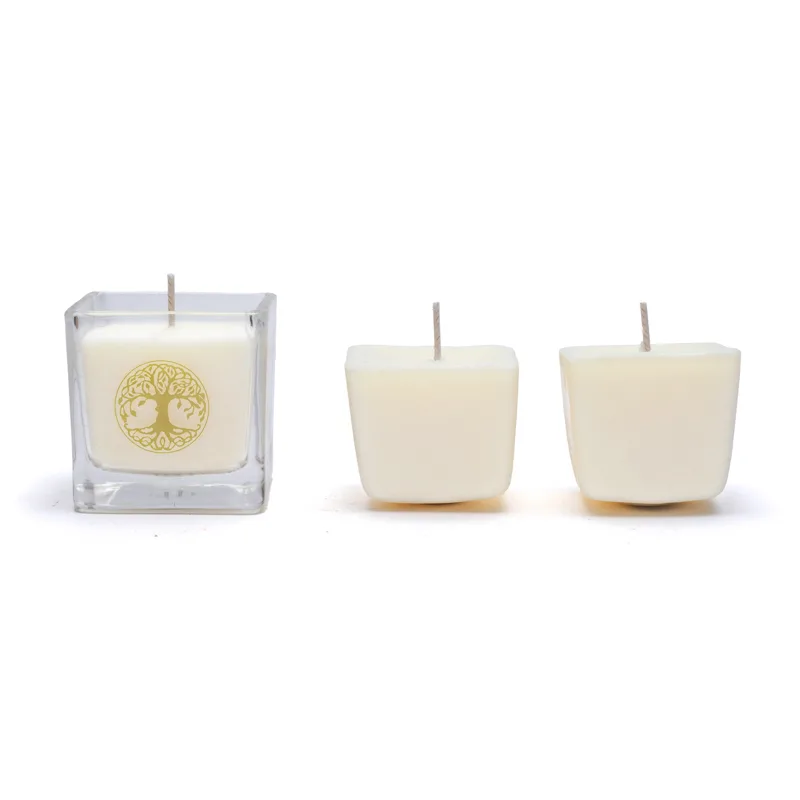





Set of 1 rapeseed wax candle in recycled glass, and two wax refills that can be placed in the glass of the first candle once completely burnt.
Scented candle, 100% vegetable ecological rapeseed wax, made in a traditional way in Belgium. With paraben-free fragrance oils. Biodegradable and therefore harmless to people and the environment.
About the Product
3 candles + 1 glass
Fragrance: Amber, oudh, sandalwood
Burning time: ± 25 hours per candle
Non-GMO rapeseed from Germany
Biodegradable
Parabens free scented oils
Rapeseed wax
Rapeseed wax is made from rapeseed oil, contains no toxic ingredients and is not harmful to the environment. Quite on the contrary, rapeseed helps and protects the soil for future crops whilst the plant produces oil and animal feed. Also, the wax is non-hazardous to humans and wildlife and has a smaller carbon footprint than for example soy wax, as it is grown, and processed in Europe.
How do you prevent a candle from tunneling?
Let the candle burn until the entire surface of the wax has melted completely. Otherwise, the candle will create a hole in the middle and only burn partially. Make sure that the melted wax is about 1 cm deep before you extinguish the flame.
We also recommend trimming the wick if it is too long, to prevent the flame from becoming too large and the candle from burning up unnecessarily. However, a wick that is too short can prevent a wide candle from melting all the way to the edges. So a correct wick length is also important for a candle to burn well. Rule of thumb: a wider candle needs a longer wick than a smaller one.
Attention!
Place out of reach of children and pets.
Do not place in a drafty spot.
Do not leave a burning candle unattended.
Place on a heat resistant surface.
When the wax is fully melted, carefully move the candle only if needed, as the wick can easy move to the side of the glass.
The tree of life in different religions and spiritual traditions
The Tree of Life is a powerful symbol that exists for centuries and worldwide in various religious and spiritual traditions.
Tree of life, Buddhism
According to Buddhist tradition, the Bodhi tree, or Bo tree, is the tree (Ficus religiosa) under which prins Siddharta sat when he attained Enlightenment around 2.500 years ago at Bodh Gaya, India, and thus became the Buddha (the Awakened-one).
Tree of life, China
In Chinese mythology, a carving of a tree of life often also depicts a phoenix and a dragon, where the dragon often represents immortality. A Taoist story tells of a tree that produces a peach of immortality every three thousand years, and anyone who eats the fruit will receive immortality.
Tree of life, Europe
Antoine-Joseph Pernety, a famous writer and alchemist in the eighteenth century, identified the tree of life with the Elixir of life and the Philosopher’s Stone.
Tree of life, Germanic paganism and Norse mythology
In Germanic paganism, trees play a prominent role, appearing in various aspects of surviving texts and even in the name of their gods. The tree of life appears in Norse religion as Yggdrasil, the world tree that expands throughout 9 realms, holding the 3 magical sources of all life: the source of wisdom and knowledge, the source of past, present and future, and the source of space, the cosmos itself.
Tree of life, Islam
Trees play an important role in the Quran also. The date palm is mentioned around 20 times and is described as coming from paradise and healing poisons. It is the tree under which Maria – according to Allah – gave birth to Jesus. About the olive tree is written: “It showed the pure river of the water of life, clear as crystal, coming from the throne of the Lamb of God. In the middle of the road and across the river grows the tree of life that bares twelve baskets of fruits every month. And the leaves of this tree serve to heal the people.”
Tree of life, Mesoamerica – the Mayan Culture
Among the Maya, the central world tree was conceived as or represented by a ceiba tree. It represents the axis mundi, the stable centre of the universe.
Tree of life, Judaism
The tree of life is mentioned in the Book of Genesis. The most well-known tree in the Garden of Eden is the tree of the knowledge of good and evil, from which Adam and Eve ate and caused them to be expelled out of paradise. Judaism also mentions the tree of life or tree of souls. This tree produces souls and thus life itself.
Tree of life, Native America
The tree of life motif is firmly present in Native American traditions, including the Ojibway cosmology. The tree of life represents all that lives on this planet and in the universe. It ‘beats’ the rhythm of life, day after day, year after year, life after life. Native Americans greatly value all that lives and are masters in keeping the balance between their own needs and what nature provides.